
CENTRIFUGAL CLUTCHES
Centrifugal Clutches — No-Load Start-Up for Your Application
Need a No-Motor Start?
Our centrifugal clutches have made it possible since 1982 — with a smaller, more cost-effective motor instead of expensive oversizing.
How Does a Centrifugal Clutch Work?
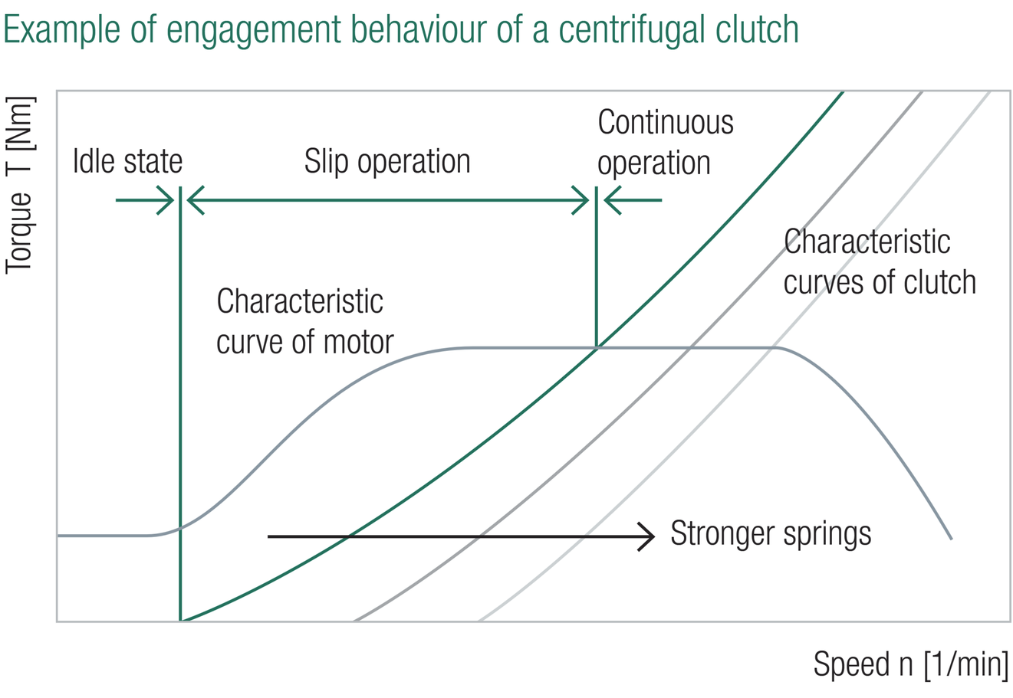
As soon as the centrifugal weights start rotating, a radial force pushes them outward. Up to the defined engagement speed, this force is offset by springs. Once the engagement speed is reached, the friction linings engage, torque builds up, and the application accelerates to its rated speed. By adjusting spring design, friction material, size, and the number of elements, we precisely tune the engagement speed and torque to your application.
Since the entire slip phase is converted into heat, keeping the slip time as short as possible is essential — our organic friction linings dissipate the resulting heat efficiently through the housing and surrounding air.

An Overview of our
Centrifugal Clutch Without Housing
Centrifugal Clutch With Belt Output
Centrifugal Clutch With Belt Tensioner
Centrifugal Clutch With Adjustable Disc
Centrifugal Clutch With Highly Flexible Coupling
Centrifugal Clutch With Custom Bolt Pattern
Centrifugal Clutch With Sprocket
Two Proven Design Types
Profile Hub
- Centrifugal elements guided via dovetail profile
- Torque transmission independent of direction of rotation
- Servo effect increases the transmittable torque
Privoting Shoe Design
- Centrifugal elements guided via pin with minimal play
- Solid carrier plate for low-vibration, low-noise operation
- Self-energizing effect similar to a duplex drum brake, with approx. 50% capacity in the reverse direction
No matter which design fits your application or which motor you use — we manufacture the clutch to your exact specifications, whether with a keyway connection or a taper bore.
Where are Centrifugal Clutches Used?
Construction Equipment
Transport Refrigeration Units
Sweepers
Chainsaws
Emergency Generators
Pump Drives
Lawn Mowers
Fans
Go-Kart Racing
Stump Grinders
Rescue Descenders
Hydropower and Wind Power Plants
Mowers
Want to Find the Right Solution?
Want to check whether a centrifugal clutch is the right solution for your application? Our team is happy to work with you on the technical design.
© copyright 2026 | Amsbeck
150 North Michigan Avenue
35th Floor
Chicago, Illinois 60601