
CENTRIFUGAL BRAKES
Reliable Speed Limiting with Centrifugal Brakes
Strong brakes you can count on — our centrifugal force, working for your safety.
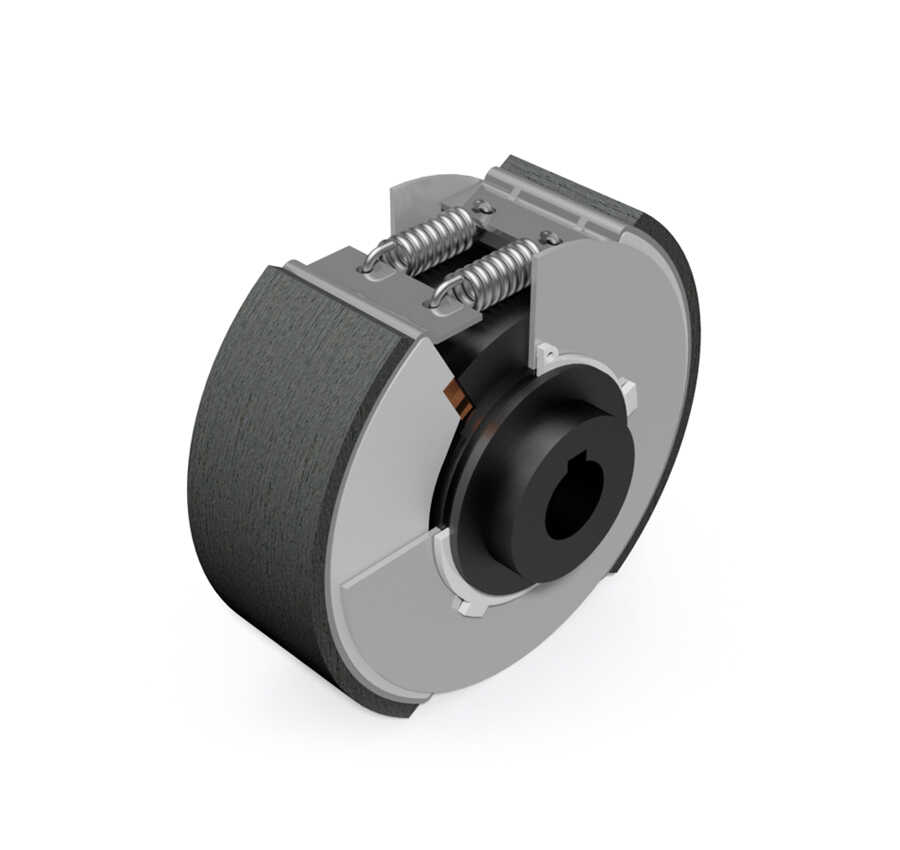
What Every Centrifugal Brake Delivers
Need a centrifugal brake to protect your users and applications? You've come to the right place. A centrifugal brake works on the same principle as our centrifugal clutches — except here the housing is fixed and secured against rotation, instead of rotating itself.
Good to know: : A centrifugal brake does not bring a system to a complete stop. Its main function is to limit speed to a safe level.
Benefits at a Glance
Technical Details
Operating Principle
Guided weight elements set into rotation experience a radial force component that accelerates them outward. This force is offset by spring force up to the defined engagement speed.
Once the engagement speed is reached, the friction linings contact the housing and torque begins to build. As speed increases, the forces rise quadratically, and torque increases accordingly. At this point, the brake enters the start of its working range. The working range lies between engagement and the point where braking torque and load torque reach equilibrium — this torque equilibrium must occur within the brake's slip range
.
As long as the centrifugal brake is not engaged — meaning spring force exceeds centrifugal force — the system operates without contact and without losses. To avoid impairing brake performance, friction surfaces must be kept free of grease, oil, and moisture.
By varying spring design, friction material, size, the number of parallel elements, and operating speed, we determine the engagement speed and braking torque and tailor them to each specific application.
Engagement
In general, the engagement speed is determined by the balance between load torque and braking torque. Since a centrifugal brake's output increases quadratically with speed, a minimum operating speed is required.
The engagement speed of a centrifugal brake is the speed at which the centrifugal force acting on the weights overcomes the restraining force of the springs. By selecting springs of different strengths — which hold the weights back for different lengths of time — the engagement speed can be adjusted. Because of this mechanism, a centrifugal brake cannot bring a system to a complete stop; it is typically used as a speed limiter.
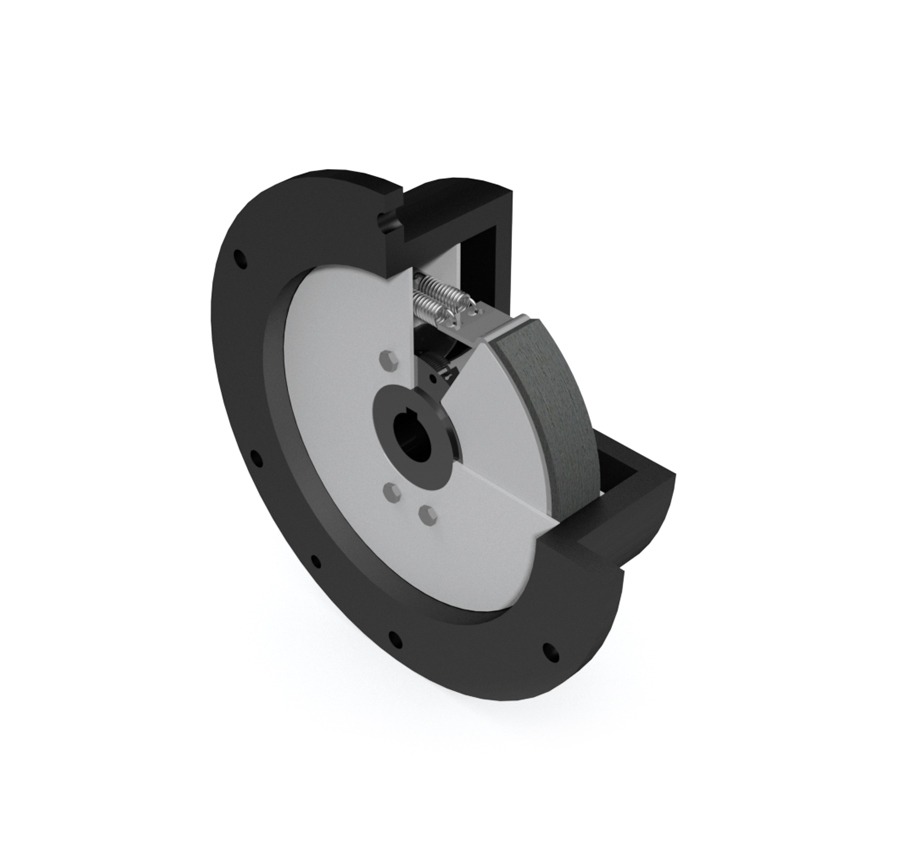
Sizing
Centrifugal brakes are typically safety-critical components, so careful sizing is essential.
The following parameters are decisive:
- Operating speed
- Engagement speed
- Frequency of braking cycles
- Braking duration
Heat Generation
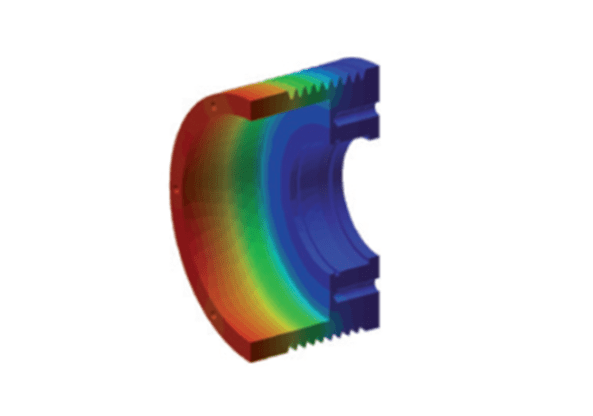
Friction generates heat, so a centrifugal brake converts all the friction work performed entirely into heat. This heat is generated directly at the friction contact and primarily heats the material directly involved in that contact (see fig.).
Heat generation depends on the specific operating conditions as well as the following factors:
- Braking torque
- Size of the friction surface
- Braking duration
Heat conduction distributes temperature throughout the entire brake. Temperature rises sharply at the start of braking and then levels off until reaching a maximum. When sizing a brake, it's important to ensure that the maximum permissible temperature at the friction contact is not exceeded, as this would otherwise significantly increase wear on the friction lining.
This thermal overload significantly alters the friction values and can negatively affect brake performance. Due to the resulting surface temperatures, protective measures around the brake may be necessary in some cases.
Construction
Every centrifugal brake consists of a profile hub, on which centrifugal weights — fitted with lining shoes and brake linings — are held together by tension springs. The internal assembly is press-fitted into the brake housing with ball bearings and secured using cover plates and retaining rings.
Fields of Application
The main application is speed limiting for the safe lowering of people or loads — from rescue descenders to recreational applications such as cable cars.

An Overview of our
Centrifugal Brake with In-Line Housing for Rack-and-Pinion Drive
Centrifugal Brake for Installation in Customer-Supplied Housing
Flange-Mounted Centrifugal Brake with Enclosed Housing
Centrifugal Brake with In-Line Housing
© copyright 2026 | Amsbeck
150 North Michigan Avenue
35th Floor
Chicago, Illinois 60601