
APPLICATION
Centrifugal Brakes for Elevator Technology
Reliable safety brake for construction hoists and maintenance platforms – limits fall speed in an emergency and protects people and material.
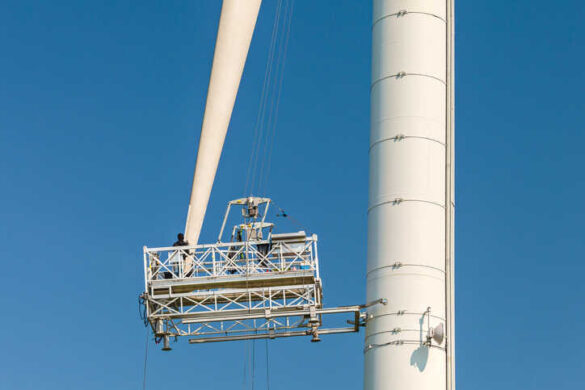
Added Safety for Construction Hoists and Maintenance Platforms
Whether it’s a facade-mounted construction hoist or a maintenance platform at height – fall speed must stay within a safe range regardless of load or duration of use, whether running empty, fully loaded, or in changing weather conditions. Our centrifugal brakes reliably limit speed in an emergency, with no need for operators to actively readjust anything.
Why precise sizing matters here:
A safety brake in elevator applications only gets one real chance to work – if it fails, people are at risk. That’s why it must be sized exactly to the weight, fall height, and speed of each specific system.
Every centrifugal brake we build is put through its paces on our own test rig before it leaves our factory.
How a centrifugal brake works as a safety brake
The brake stays inactive during normal operation and only engages once a critical speed is reached.
We’ve been delivering this principle for over 40 years in brakes for elevators and maintenance platforms – built for higher heat loads and larger torques.
1. Centrifugal weights
Only above the permitted speed do the centrifugal weights move outward.
3. Fail-safe principle
The brake works purely mechanically, with no power supply or sensors required.
2. Friction linings
They generate the braking torque and slow the fall speed.
4. Result
People and material reach the ground in a controlled manner instead of free fall.
The right safety brake for your elevator system
These factors go into the sizing
very system is different – that’s why we calculate brake sizing individually based on the following parameters.
01. Fall height
Determines how much energy the brake must absorb in an emergency.
02. Load capacity
Empty and full load of the cab or platform affect the required braking force.
03. Trigger speed
The threshold speed at which the brake engages.
04. Heat generation
High fall energy creates significant friction heat in the brake system.
05. Installation conditions
Available space and integration with existing elevator technology.
06. Weather exposure
Dust, weather, and temperature fluctuations on the job site.
Häufige Fragen zu Fliehkraftbremsen für Zipline & Sommerrodelbahn
Wie oft muss eine Fliehkraftbremse gewartet werden?
Wir fragen zunächst per Fragebogen die wichtigsten technischen Eckpunkte ab. Danach prüfen wir, welche Baugröße aus unserem Baukastensystem passt und ob bereits geeignete Komponenten existieren. Auf dieser Basis erarbeiten wir einen ersten Konstruktionsvorschlag, den wir mit Ihnen abstimmen, bevor Sie ein Angebot erhalten.
Funktioniert die Bremse auch bei Nässe und Frost?
Ja, sie ist für den Dauereinsatz im Freien ausgelegt und arbeitet zuverlässig bei Wind, Nässe und niedrigen Temperaturen.
Kann die Bremse nachgerüstet werden oder nur bei Neubau?
Das hängt vom Umfang ab: Ist die Anwendung bereits bekannt, kann eine Entwicklung in wenigen Tagen stehen. Bei komplett neuen Anforderungen mit höherem Abstimmungsbedarf kann es einige Wochen dauern.
Wie lange dauert die individuelle Auslegung?
Ja, wir beraten Sie bei jeder Anfrage zur passenden Auslegung. Wir verstehen uns als Problemlöser und begleiten Sie, bis die beste Lösung für Ihre Aufgabenstellung gefunden ist.
How the collaboration works
1. Inquiry & Consultation
You tell us the system type, load capacity, and fall height.
2. Custom Sizing
We calculate the right safety brake.
3. Made-to-Order Manufacturing
We build it using heat-resistant specialty materials.
4. Delivery & Installation
We deliver it ready to install for your elevator system.
Frequently asked questions about centrifugal brakes for elevator technology
Does the brake work purely mechanically, or does it need power or sensors?
No – the centrifugal principle works purely mechanically based on rotational speed, with no external power source required. That’s exactly what makes it so reliable as a safety brake.
Does the brake need regular maintenance or trigger testing?
Yes, like any safety component, the brake should be inspected regularly.
Can an existing elevator system be retrofitted?
In principle, a centrifugal brake can be retrofitted – the details need to be checked with the system’s manufacturer.
Do you offer technical consultation for sizing?
That depends on the brake’s size and other factors that are part of the individual sizing process.

Our Application Areas at a Glance
Centrifugal Brakes & Clutches for Every Application
Request Your Safety Brake Inquiry Now
Let’s work together to size the right safety brake for your elevator system.
Talk to our team!
© copyright 2026 | Amsbeck

Boschweg 15
D-48351 Everswinkel
Deutschland
Our applications in the area of
Centrifugal brakes for lifting and access equipment
Lifting and hosting systems
Centrifugal brakes are used in construction elevators and maintenance platforms as an additional safety mechanism. In emergency situations, they limit descent speed to ensure that personnel and equipment are lowered safely and in a controlled manner.
Amsbeck offers high-torque brake solutions designed to handle extreme heat loads using specialized materials.


Typical products for application
Centrifugal brakes for lift systems. You are welcome to discuss technical interpretations with our team.
Centrifugal brakes play a critical role in safety-critical lifting applications where uncontrolled descent must be prevented under all operating conditions. These systems are commonly integrated into construction hoists, mast climbing platforms, and suspended access equipment to provide redundant braking in case of drive failure or overspeed situations.
A key advantage of centrifugal braking systems in lifting technology is their speed-dependent activation, enabling automatic response without external control systems. This makes them particularly suitable for fail-safe designs where reliability and independence from electronic systems are required. Engineers benefit from predictable engagement behavior and consistent braking performance across varying load conditions.
Amsbeck centrifugal brakes are engineered for high cycle durability and thermal stability, ensuring reliable operation even under repeated emergency braking scenarios. The use of advanced friction materials and optimized brake geometries allows for efficient heat dissipation and minimal wear, extending service intervals and reducing maintenance requirements.
Typical integration scenarios include:
- construction elevators and temporary hoists
- lifting systems in industrial plants
- vertical transport systems with safety requirements
In addition to standard solutions, Amsbeck provides application-specific brake designs tailored to load profiles, descent speeds, and environmental conditions. This includes customization for compact installation spaces, specific torque requirements, and compliance with relevant safety standards.
© copyright 2026 | Amsbeck
150 North Michigan Avenue
35th Floor
Chicago, Illinois 60601