

Reliable speed control for safety-critical
applications
Centrifugal brakes
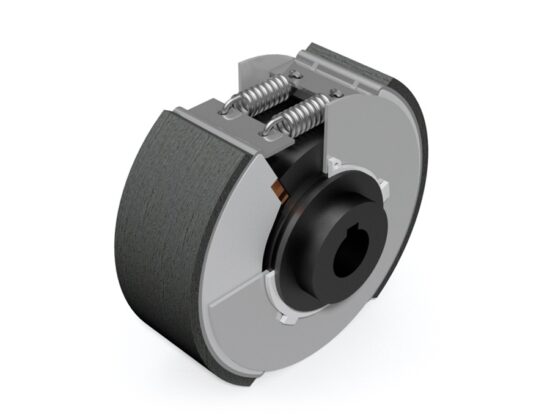
Centrifugal brake without housing
How a centrifugal brake works
Do you need a centrifugal brake to protect your equipment and users? Here you will find an overview of how Amsbeck centrifugal brakes function and where they are used.
A centrifugal brake works on the same basic principle as a centrifugal clutch. In a clutch, the housing rotates once the engagement speed is reached and transmits torque as speed increases. In a centrifugal brake, the housing is fixed and secured against rotation.
Good to know: A centrifugal brake does not bring a system to a complete stop. Its primary function is to limit speed to a safe level.
Operating principle of centrifugal brakes
As the rotating elements spin, centrifugal force pushes the weights outward. This force is balanced by spring force up to the defined engagement speed.
Once the engagement speed is reached, the friction linings contact the housing and torque begins to build. As speed increases, the forces and braking torque increase as well.
The operating range lies between engagement speed and the point where braking torque equals load torque. This balance must occur within the slip range of the brake.
When the brake is not engaged, the spring force exceeds the centrifugal force. The system runs without contact and without losses. To ensure proper function, friction surfaces must remain free of grease, oil, and moisture.
By adjusting springs, friction material, size, number of elements, and operating speed, both engagement speed and torque can be tailored to the specific application.
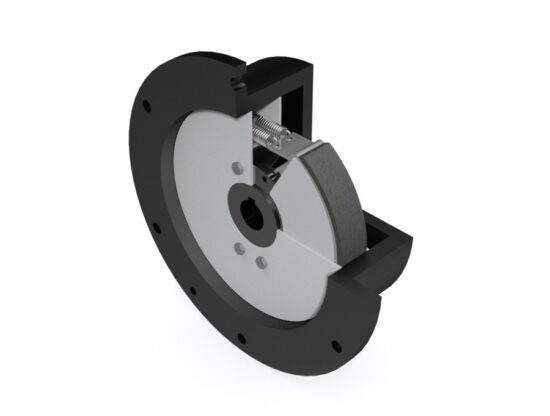
Centrifugal brake
Engagement behavior the centrifugal brakes
The engagement speed depends on the balance between load torque and braking torque. Since braking performance increases with speed, a minimum operating speed is required.
The engagement speed describes the point at which centrifugal force overcomes spring force. By selecting springs with different stiffness levels, the engagement speed can be adjusted. Because of this principle, a centrifugal brake cannot bring a system to a full stop. It is primarily used as a speed limiter.
Sizing considerations
Centrifugal brakes are safety-relevant components, so proper sizing is critical. The following parameters must be considered:
- Operating speed
- Engagement speed
- Frequency of braking cycles
- Braking time
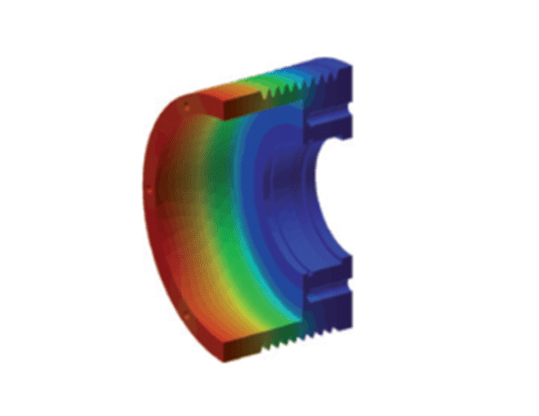
Heat generation in the centrifugal brake
Friction generates heat. During operation, the brake converts friction energy entirely into heat. This heat is generated at the friction surfaces and depends on:
- Braking torque
- Contact surface area
- Braking time
Heat is distributed throughout the brake via conduction. Temperature rises quickly at the start of braking and stabilizes over time.
When designing the system, maximum allowable temperatures must not be exceeded. Excessive heat leads to increased wear, changes in friction characteristics, and reduced performance. In some cases, protective measures around the brake may be required due to surface temperatures.
Design and construction of the centrifugal brake
Each centrifugal brake consists of a profiled hub with centrifugal weights connected via springs and friction linings.The internal components are mounted within the brake housing using bearings and secured with cover plates and retaining rings.
Typical applications:
Centrifugal brakes are primarily used for controlled speed reduction in safety-related applications, including:
- Lowering people or loads from height
- Door systems and fire protection curtains
- Recreational applications such as zip lines
Where centrifugal brakes are used
The main function is speed limitation. They are commonly used in descent devices that safely lower people in emergency situations. Additional applications include cranes, elevators, door systems, and fire curtains. They are also used in recreational systems such as ropeways.
Benefits of Amsbeck centrifugal brakes
- Provides an additional mechanical safety function
- Ideal as a backup to electronic braking systems
- Operates independently of external power sources
- Ensures controlled and reliable speed reduction
- Available without housing if a drum is already provided
- Easy and cost-effective replacement of wear parts
- Designed specifically for your application
- Over 40 years of experience in drive technology
Get in touch
Would you like to find out if a centrifugal brake is the right solution for your application? Contact us by phone, email, or through our contact form. Our team will be happy to support you with the technical design.
© copyright 2026 | Amsbeck
150 North Michigan Avenue
35th Floor
Chicago, Illinois 60601